The Temple in the Middle of a River
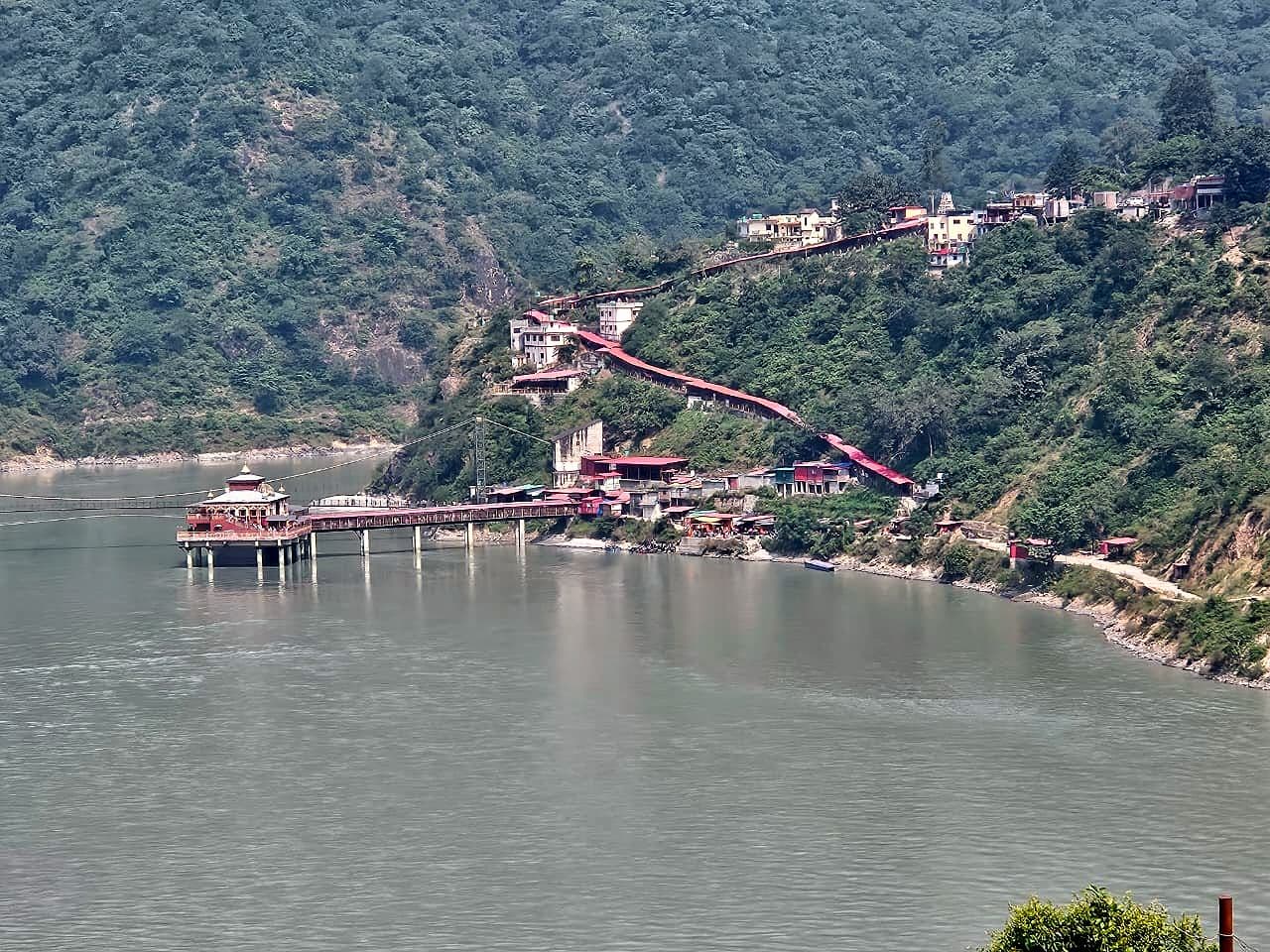
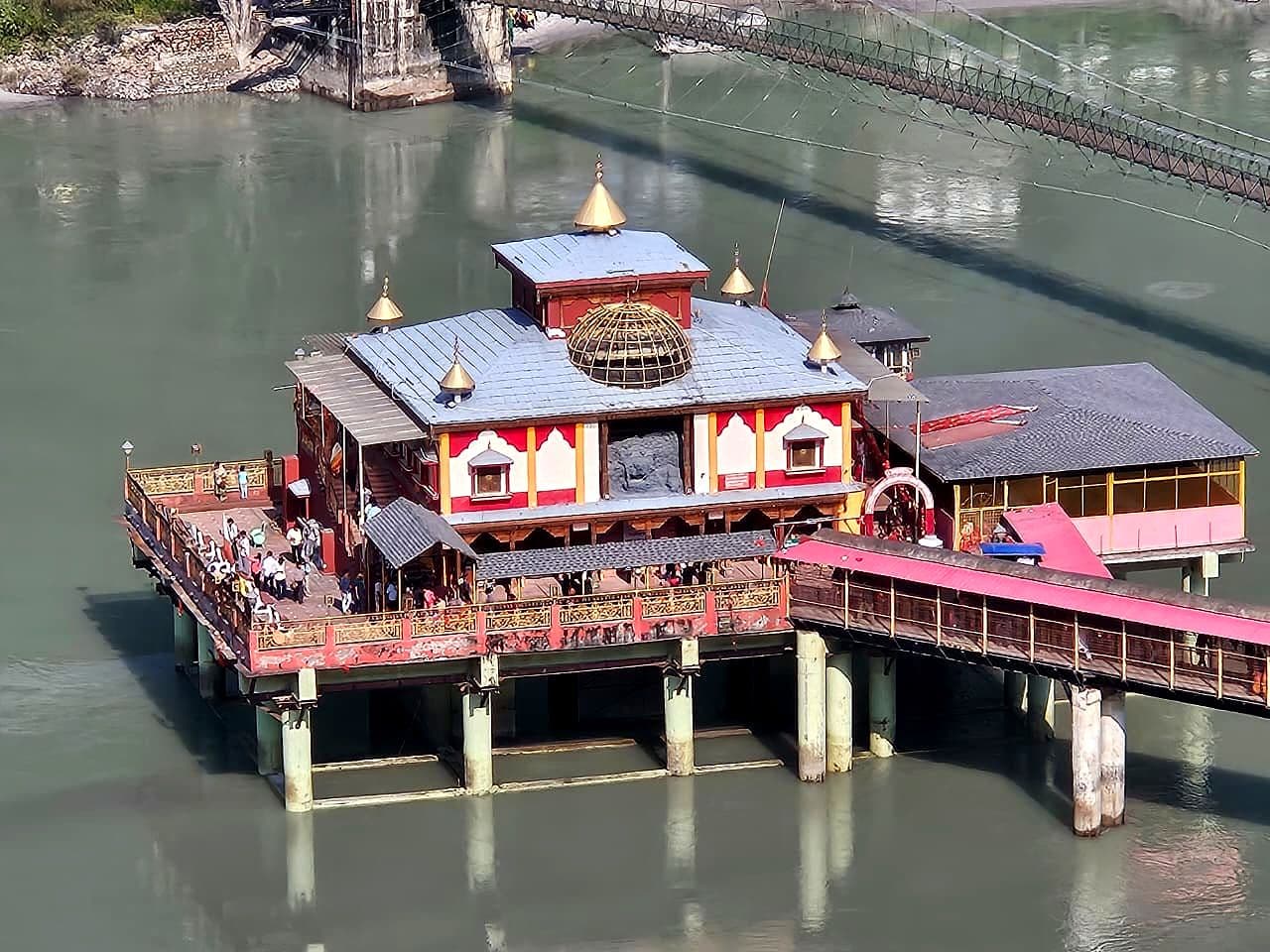
There is nothing else quite like it on the Char Dham road. You come down off the Srinagar–Badrinath highway at Kalyasaur, walk a few hundred metres, cross a footbridge over the Alaknanda — and there sits the shrine, raised on a platform with the green river rushing around it on all sides. No roof over the idol. That is not an oversight; it is the rule. Local belief holds that the goddess must never be kept under a roof, and every attempt over the years to cover her has, in the telling, failed.
Most travellers pass this spot without knowing what it is. Those who stop find one of the most atmospheric temples in Garhwal — and, if they ask, one of its most charged stories.
Dhari Devi at a Glance
The Story — Guardian of the Char Dham, and the 2013 Flood
Two stories sit on top of each other here, and both matter.
The older legend gives the goddess her name. Centuries ago a great flood swept the valley and carried her idol downstream until it lodged against a rock near the village of Dhari. Villagers heard a cry coming from the water, found the idol, and a divine voice told them to install her right there. They did, and she became Dhari Devi — the bearer, the one who holds and protects. Over time she came to be seen as the guardian deity of all of Uttarakhand and, specifically, the protector of the four dhams. This is why the custom is to seek her darshan before going up to Kedarnath and Badrinath: the yatra is felt to be incomplete, and unprotected, without her blessing.
The recent story is the one every Uttarakhandi will tell you. On 16 June 2013, to clear the way for the Srinagar hydroelectric project, the idol was lifted from its ancient rock in the river and moved to a raised concrete platform. Priests and locals had warned against it. Within hours — the night of 16–17 June — the Kedarnath cloudburst hit, and the floods that followed killed thousands across Rudraprayag, Chamoli and Uttarkashi. To believers, the timing was not a coincidence; it was the goddess's anger at being moved from her mool sthan, her original seat. Older residents point out that a similar relocation attempt by a local ruler in 1882 is remembered for a landslide that damaged Kedarnath. Whether you read it as faith or as coincidence, the story is now inseparable from the place — and it is a large part of why devotion here has only deepened since.
Why the Idol "Changes Face" Three Times a Day
Ask the priests and they will tell you the stone face of Dhari Devi shifts through the day — a girl (bal roop) in the morning, a young woman by midday, an old woman by evening. It is a belief, not a measured physical change, and it is one of the shrine's most famous features. Alongside it runs another striking detail: only the upper half of the goddess is worshipped here. The lower half is at Kalimath, about 100 km away in Rudraprayag district, where she is worshipped as Kali. The two shrines together make one goddess — which is why devout pilgrims try to visit both.
The shrine counts among the 108 Shakta pithas named in the Devi Bhagavata, giving it weight well beyond its modest size. It is a small stone temple, not a grand one — and that plainness, with the river roaring underneath, is exactly its power.
Darshan Timings, Aarti & Temple Rules
The temple is open through the year, roughly 6:00 AM to 8:00 PM, with morning and evening aartis as the high points. If you can time it, come for the evening aarti — lamps, bells and the Alaknanda going gold at sunset is the memory people carry home. A few rules worth knowing before you go:
- Photography is prohibited inside the sanctum. Phones down at the idol — this is enforced.
- Devotees who have a wish fulfilled traditionally offer a bell; the premises are hung with hundreds of them.
- It is a short but real walk down and across the footbridge — wear proper shoes, and mind the steps in the wet.
- Prasad and offerings are sold at stalls on the highway above; buy there, not at the platform.
Best Time to Visit
Go March to June or September to November — pleasant weather, clear river views, safe roads. The temple is busiest and most alive during Chaitra Navratri (spring) and Ashwin/Sharad Navratri (autumn), when special pujas run and the shrine is decorated; if you want the atmosphere at full strength, come then and expect crowds. Avoid July–September: the monsoon brings landslides and road closures on this stretch, and in late August 2025 the swollen Alaknanda rose to touch the temple platform for the first time since 2013 — a reminder that this is a river shrine, and the river has the last word.
How to Reach Dhari Devi Temple
The temple sits right on the main Rishikesh–Rudraprayag–Badrinath road, so if you are doing Kedarnath or Badrinath you pass within sight of it. The last leg is always the same: reach Srinagar Garhwal, continue ~15 km on the Badrinath highway to the Kalyasaur board, then walk down and across the footbridge.
By road
From Delhi it is about 340–360 km via Haridwar, Rishikesh, Devprayag and Srinagar — a 9–10 hour drive, best broken with a night at Haridwar or Srinagar. Regular buses and shared taxis run Rishikesh → Srinagar → Rudraprayag and drop at the Kalyasaur stop; a private cab is far more comfortable for families and seniors, especially in monsoon.
By train
The nearest useful railheads are Rishikesh (~118 km) and Haridwar (~140 km), both well connected from Delhi and beyond. From either, it is road the rest of the way.
By air
The nearest airport is Jolly Grant, Dehradun (~135 km), with daily flights from Delhi, Mumbai, Bengaluru and Hyderabad. Take a taxi from there toward Srinagar.
Distance Chart to Dhari Devi Temple
What Else to See Nearby
Dhari Devi pairs naturally with a handful of stops on the same road. Koteshwar Mahadev, a Shiva cave temple by the Alaknanda, is about 3 km away. Srinagar Garhwal (15 km) has Kamleshwar Mahadev and an old bazaar. Rudraprayag (20 km) marks the sacred confluence of the Alaknanda and Mandakini. If you have a spare half-day, the hilltop Kartik Swami temple (~16 km, short trek) rewards you with one of the finest Himalayan viewpoints in Garhwal. And of course the road from here runs straight on to Kedarnath and Badrinath.
Visiting Dhari Devi on Your Char Dham or Do Dham Yatra
Because she guards the four dhams and sits on the road everyone already drives, adding Dhari Devi costs you 30–40 minutes, not a day. On our Char Dham and Do Dham itineraries we build the Dhari Devi stop into the Srinagar–Rudraprayag leg, so you take her blessing before the climb to Kedarnath — the way pilgrims have done it for generations. If you only want the temple itself, a short 3N/4D Srinagar-based darshan trip from Haridwar covers it comfortably; tell us your dates and we will plan around them.
Add Dhari Devi to Your Yatra — We Plan the Whole Route
Char Dham, Do Dham or a short Dhari Devi darshan trip · Direct Haridwar operator
Sources: District Pauri Garhwal (Govt. of Uttarakhand), Wikipedia — Dhari Devi. Distances are road distances and vary slightly by route and source.
People Also Ask
The questions pilgrims most commonly search on Google about this yatra.