Badrinath — the abode of Lord Vishnu in the Garhwal Himalayas — is one of the most sacred dhams in Hinduism and the final stop on the Char Dham Yatra circuit. Set at 3,133 metres on the banks of the Alaknanda river, the Badrinath temple is fully motorable — meaning pilgrims of all ages, including those who cannot trek, can reach the temple by road. The famous Tapt Kund natural hot spring sits just below the temple, where devotees take a ritual bath before darshan.
Badrinath Yatra Itinerary — 2N/3D from Haridwar
Quick answerBadrinath Yatra from Haridwar is a 2N/3D all-inclusive package from ₹4,500 per person with Shiv Ganga Travels — AC cab, hotels, meals and darshan assistance. Badrinath is reachable by motor road (no trek), at 3,133m in Chamoli district. The opening date is announced on Basant Panchami at the Narendra Nagar Raj Darbar; in 2026 the doors opened on April 23 and the season runs to November.
Day 1Haridwar → Joshimath (270 km)
Depart Haridwar early morning via Rishikesh, Devprayag (Alaknanda-Bhagirathi confluence), Rudraprayag, Chamoli. Arrive Joshimath by evening. Overnight stay. Visit Narasimha Temple if time permits.
270 km drive8–9 hrsOvernight Joshimath
Day 2Joshimath → Badrinath — Darshan Day
Drive 46km to Badrinath (1 hr). Take dip in Tapt Kund hot spring. VIP darshan at Badrinath temple. Visit Brahma Kapal, Mana Village (officially India’s first village, long called the last before Tibet), Vyas Gufa, Bhim Pul, and the source of Saraswati river. Evening aarti. Overnight stay near Badrinath.
Morning prayer at the temple. Drive back to Haridwar via the same scenic route. Arrive Haridwar by evening. End of yatra.
Return journeyArrive evening
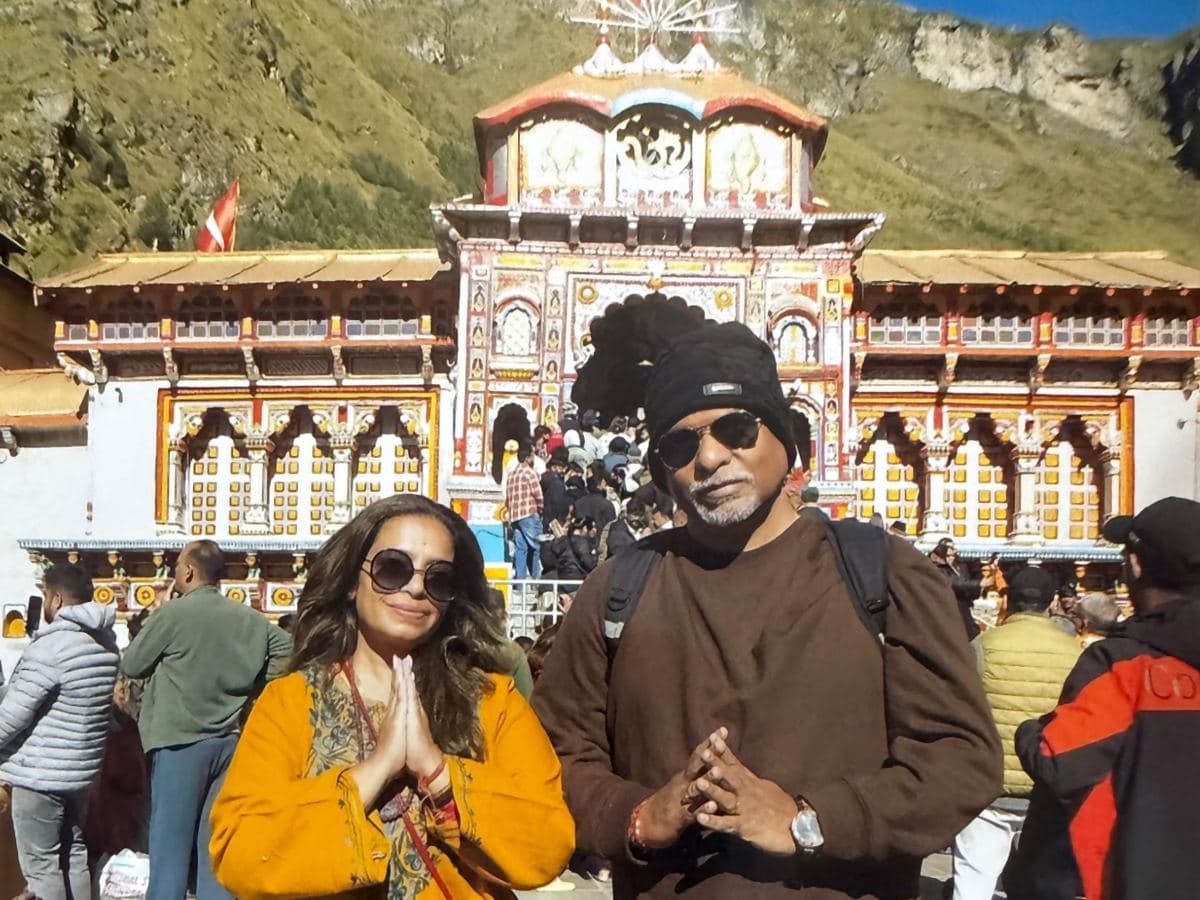
Sunirmal Ji and his wife at the Singh Dwar, the painted main gate of Badrinath Temple, on their darshan day with us. Clear sky and bright sun, and still a sweater and woollen cap: at 3,133 m the air stays cold, so pack layers whatever the forecast says. Photo shared by Sunirmal Ji, Badrinath, 19 September 2026.
The Badrinath Temple is dedicated to Lord Badrinarayan (Vishnu) and is one of the Char Dhams and also part of the Chota Char Dham circuit. The temple was built in the 8th century CE and sits on the right bank of the Alaknanda river. The presiding deity, Badrivishal, is a 1-metre tall black stone image of Lord Vishnu in a meditative pose. Morning Abhishek puja begins at 4:30 AM and the temple remains open until 9 PM.
Temple timing
Opens 4:30 AM · Closes 9:00 PM
Morning Abhishek
4:30 AM — 6:00 AM (special puja)
Darshan time
7:00 AM — 1:00 PM · 3:00 PM — 9:00 PM
Tapt Kund bath
Before temple entry (natural hot spring)
Dress code
Traditional attire preferred; no shorts
Phone restriction
Photography restricted inside sanctum
Places to See Near Badrinath
Mana Village
3 km
Officially India’s first village since 2022, long called the last before the Tibet border. Visit Vyas Gufa (cave where the Mahabharata was composed) and Bhim Pul (natural rock bridge). Most pilgrims regret skipping it.
Brahma Kapal
0.5 km
Sacred platform on the bank of Alaknanda where Hindu pilgrims perform Pind Daan (ancestral rites) for departed souls.
Tapt Kund
At temple
Natural sulphur hot spring where water temperature stays around 45°C. Devotees take a holy dip before darshan — believed to cure skin ailments.
Narad Kund
Near temple
Where the original Badrivishal idol was found by Adi Shankaracharya. Small but spiritually important.
Vasudhara Falls
9 km trek
145-metre waterfall on the Saraswati river. The walk from Mana village takes about 3 hours round trip. Only water falls on the pure of heart (legend).
Best Time to Visit Badrinath
The Badrinath temple opens in late April and closes in November. The best months are May and September–October. May offers clear skies, manageable crowds, and excellent weather (8–14°C). September and October bring post-monsoon visibility and fewer pilgrims than May–June, though the weeks before the winter closing still fill the temple. Avoid July–August — the monsoon brings heavy rainfall, frequent landslides on the Joshimath route, and disrupted travel.
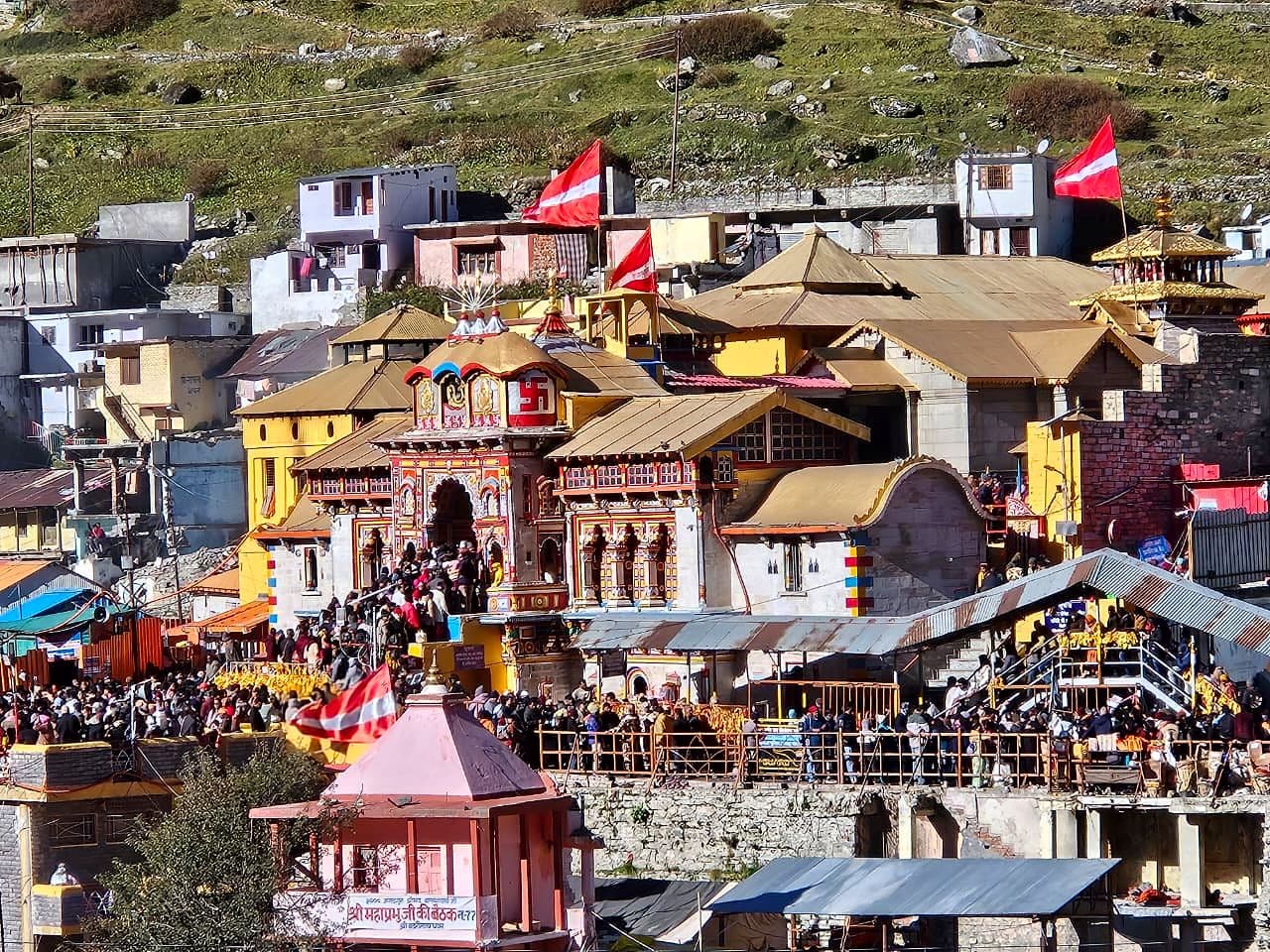
Badrinath on Thursday, 8 October 2026: a weekday, clear sky, and the forecourt below the Singh Dwar packed with pilgrims. October is quieter than May–June, not empty. Once the closing date is announced, many families try to fit in darshan before the doors shut, so plan for a queue. Photo: Shiv Ganga Travels, Badrinath Temple, 8 October 2026.
Badrinath Temple Darshan Timings 2026
Morning opening4:30 AM
Maha Abhishek puja4:30 – 6:30 AM
Morning darshan7:00 AM – 1:00 PM
Afternoon closure1:00 – 4:00 PM
Evening darshan4:00 – 9:00 PM
Evening aarti8:00 PM
The Maha Abhishek at 4:30 AM is the one worth getting up for — the temple at first light with Neelkanth behind it. It needs booking in advance. Timings shift slightly on festival days and are set by the temple committee.
How to Reach Badrinath from Haridwar
Badrinath is 320 km from Haridwar and takes 10–11 hrs of driving. That ratio is the single most useful fact here: it works out under 30km/h, and pilgrims who plan from the distance alone arrive four hours later than they expected, in the dark, at 3,133m. The route runs Rishikesh → Devprayag → Rudraprayag → Karnaprayag → Chamoli → Joshimath.
Haridwar to Badrinath road route, stage by stage
Stage
Distance
Time
Road notes
Haridwar → Rishikesh
25 km
45 min
Flat, easy. The last plains driving you get.
Rishikesh → Devprayag
70 km
2 hrs
The Ganga on your right the whole way. Where the Bhagirathi and Alaknanda meet.
Devprayag → Rudraprayag
70 km
2 hrs
Steady climb along the Alaknanda. Srinagar is the one real town.
Rudraprayag → Chamoli
75 km
2.5 hrs
Through Karnaprayag and Nandprayag. Two more confluences.
Chamoli → Joshimath
50 km
2 hrs
The Helang stretch. Slowest section of the route and the first to close in rain.
Joshimath → Badrinath
45 km
2 hrs
Narrow, high, one-way gate control in places. Vishnuprayag below you.
Haridwar → Badrinath
320 km
10–11 hrs
Most groups break the drive at Rudraprayag or Joshimath.
Badrinath is the longest single leg of the Char Dham and the one people most often underestimate. It is 320 km, which on a plains highway is four hours. Here it is ten to eleven, because from Rudraprayag onward you are on a road that climbs 2,800 metres while following a river gorge, and the Chamoli–Joshimath section has been under near-permanent widening and slide repair. Add the 10 PM to 4 AM night-driving ban on all Char Dham routes and a single-day run from Haridwar means leaving before dawn and still arriving tired.
Worth knowing: Joshimath has had significant ground subsidence since 2023 and remains monitored. The highway runs and the town functions, but conditions change — ask before you fix dates.
🕌 Badrinath Yatra 2026 — Season Open Apr 23
Book Your Badrinath Yatra — Direct Operator
Zero commission. Free itinerary within 2 hours. 25% advance confirms your booking.
The questions pilgrims most commonly search on Google about this yatra.
Badrinath Dham opens on April 23, 2026, at 6:15 AM (Brahma Muhurta), and stays open until roughly mid-November. Daily darshan typically runs 4:30 AM–1:00 PM and 4:00 PM–9:00 PM.
Badrinath is fully motorable — no trek. From Haridwar it's about 320 km (10–12 hours) via Rishikesh, Devprayag and Joshimath. Nearest airport is Jolly Grant, Dehradun (~310 km); nearest railhead is Rishikesh/Haridwar. Joshimath, 42 km away, is the last major stop before the temple.
May–June and September–October. September–October offers the calmest experience with shorter queues, while May–June is pleasant but very crowded with higher hotel rates. Mornings can drop to 5°C even in summer, so carry layers.
Tapt Kund is a natural hot-water spring on the bank of the Alaknanda, just below the temple entrance. Pilgrims traditionally take a dip here — the water sits around 45–55°C — before entering for darshan. It's believed to have purifying and healing properties.
Yes. A free e-pass via the Uttarakhand Tourist Care portal is mandatory; the registration checkpoint is at Pandukeshwar, about 24 km before Badrinath. Carry the QR pass on your phone and as a printout.
Mana Village — officially India’s first village (long called the last before the Tibet border), about 3 km away — plus Vasudhara Falls, Bheem Pul, the Saraswati river origin, and Brahma Kapal for ancestral rituals. Auli, above Joshimath, is a popular add-on by road (its ropeway has been shut since January 2023).