Kedarnath temple opens on April 22, 2026 and is accessible via a 16km trek from Gaurikund (1,982m) to the shrine at 3,583m. The one-way trek takes 5–7 hours on foot; pony is available for ₹3,000–4,500 one way (official pony, palki and kandi rates); helicopter from Phata/Sersi/Guptkashi costs ₹6,390–12,762 round trip. A registered Haridwar operator like Shiv Ganga Travels offers complete 3N/4D packages from ₹5,250 per person all-inclusive. Biometric registration is mandatory — pilgrims without a printed QR certificate are turned back at Sonprayag, even after a 7-hour drive.
Kedarnath is one of the 12 Jyotirlingas of Lord Shiva — the only one in the Himalayas. The current stone temple was built by Adi Shankaracharya in the 8th century CE on a site venerated since the Mahabharata era (the Pandavas sought Shiva's penance here after the Kurukshetra war). The structure survived the 2013 cloudburst that killed over 5,000 people in the valley — a massive boulder deflected the floodwaters around the shrine and still stands directly behind the temple. Every season, approximately 15–20 lakh pilgrims attempt the trek. On peak May days, the darshan queue stretches 4–6 hours for general pilgrims. Our VIP darshan arrangement, included in all packages, reduces this to under 30 minutes.
Kedarnath Yatra Packages 2026
Quick answerKedarnath Yatra from Haridwar costs ₹5,250 per person for a 3N/4D all-inclusive package — AC cab, Guptkashi hotel, breakfast and dinner, and VIP darshan. The temple opens 22 April 2026; reaching it is a 16km trek from Gaurikund, or a helicopter from Phata/Sersi/Guptkashi (₹6,390–12,762 round trip). Pony/palki are available for seniors.
Kedarnath Trek — All 6 Stages, Exact Distances & What You'll See
The trek begins at Gaurikund (1,982m) — the roadhead 235km from Haridwar where private vehicles stop. Shared jeeps run Sonprayag to Gaurikund (₹40/person). The trail is stone-paved for most of its 16km length. In peak season, start before 6 AM — this is the single most important piece of timing advice we give every Kedarnath pilgrim. The queue at the temple grows sharply from 8 AM and peaks between 11 AM–2 PM with waits of 3–5 hours. Pilgrims leaving Gaurikund by 5:30 AM typically reach Kedarnath by 11–12 PM, attend the 1 PM aarti, and descend to Gaurikund the same evening before dark.
Stage
From start
Altitude
What to know
Gaurikund
0 km
1,982m
Take dip in hot spring kund (48°C, believed sacred). Buy trekking stick ₹50–100. Get registration checked at police post. Pony booking counter is here.
Jungle Chatti
4 km
2,350m
First rest point. Medical post with oxygen. Chai stalls. Take a 10-min rest. 45 min–1.5 hrs from start depending on pace. Good landmark to assess your group's fitness.
Bheembali
6.5 km
2,750m
GMVN rest house with rooms. Best lunch stop — simple hot food available. Medical camp. This is roughly halfway. Altitude effects may begin here — watch for headache.
Lincholi
9 km
3,200m
Last major stop before trail steepens sharply. Oxygen cylinder available (₹100–200). Fill water here — less reliable above. If anyone feels unwell, this is the last safe descent point.
Base Camp
13 km
3,550m
Temporary huts and shelters. Last food and water. Trail is virtually flat from here to the temple. The tented accommodation here is the option if you want to stay overnight at Kedarnath.
Kedarnath Temple
16 km
3,583m
One of 12 Jyotirlingas. Bag check at gate — no photography inside the garbhagriha. VIP queue is separate from general. Queue early morning or after 5 PM for shortest waits.
Trek vs Pony vs Helicopter — Honest Comparison
🥾 On foot
Free
⏱ 5–7 hrs ascent · Ages 18–65, good health
✓ Most spiritually meaningful. See every metre. No booking. You control your pace.
✓ Less tiring. Government-fixed rate displayed at Gaurikund. Ponies know every stone.
✗ One way only. Book at Gaurikund counter on the day — no advance booking. Descent separately.
🛕 Palki / Doli
₹9,200–15,200 one way, by weight
⏱ 5–7 hrs (carried) · Elderly, physically limited
✓ Zero effort. 4–6 bearers rotate. Best non-air option for 70+ pilgrims.
✗ Uncomfortable on steep sections. Negotiate price with registered porter cooperative before starting.
🚁 Helicopter
₹6,390–12,762 round
⏱ 7 min each way · All ages. Mandatory 70+
✓ No altitude stress. VIP darshan included. Views of Kedarnath valley from above are extraordinary. Weather delays possible.
✗ Weather-dependent. Book via heli.irctc.co.in — May slots sell out by February. Early booking essential.
Temple Timings, Pujas & Darshan 2026
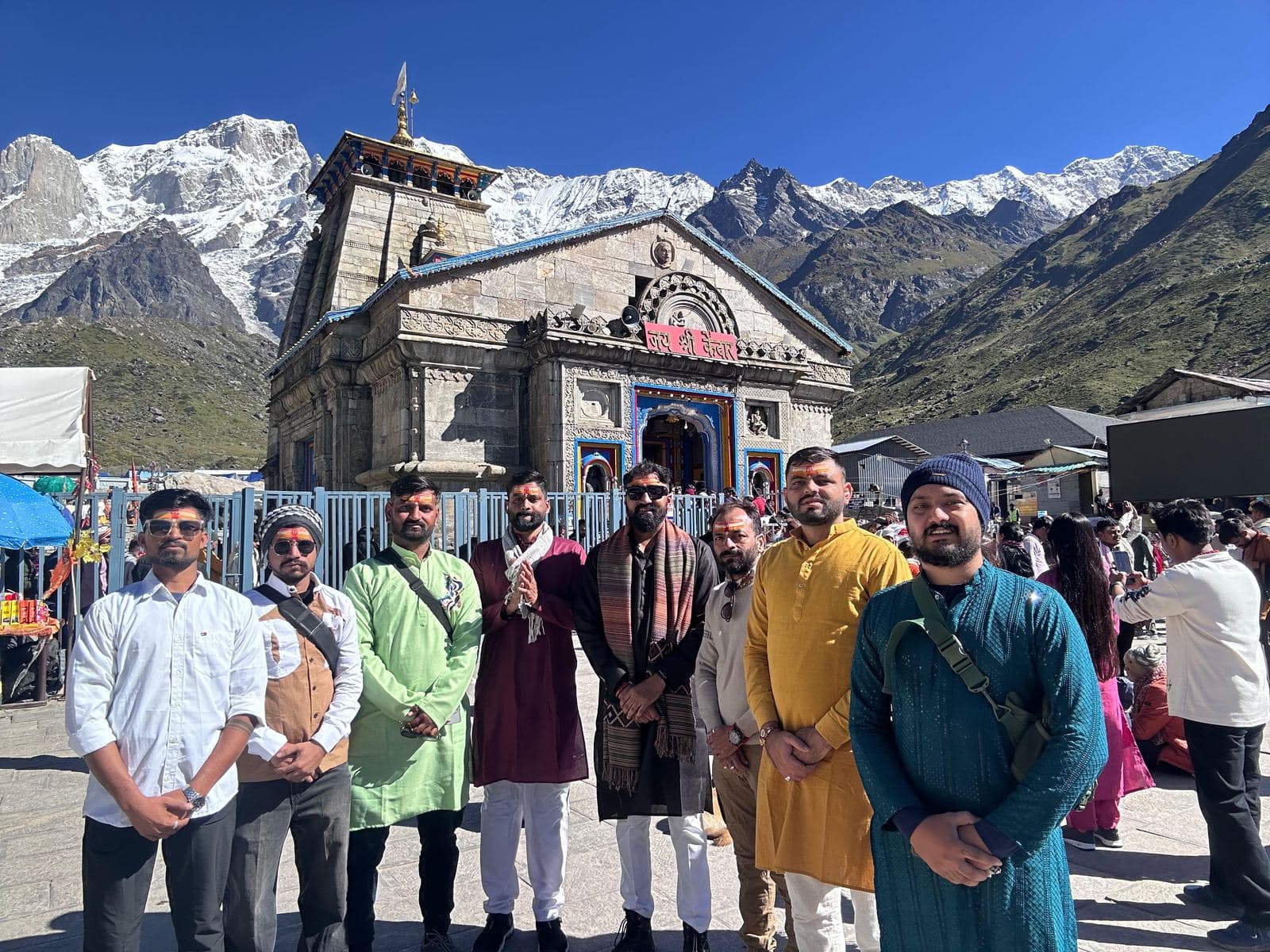
At Kedarnath Temple: eight pilgrims who travelled with us, under the red Jai Shri Kedar banner over the entrance, with snow on the peaks behind. Photo: Shiv Ganga Travels, Kedarnath Temple, 29 September 2026.
The Kedarnath temple schedule is set by the Badrinath-Kedarnath Temple Committee (BKTC). The Mahabhishek at 4:30 AM — where the Shivling is bathed with milk, curd, honey, and ghee by the head priest — is the most sacred ritual of the day. You can pre-book participation through your operator or directly at the BKTC desk. The evening aarti at 7 PM is the most visually dramatic: lamps, incense, conch shells, and drums in complete darkness at 3,583m. Every pilgrim who stays overnight rates it as the defining moment of their yatra.
4:30 AM
Mahabhishek
Milk, curd, honey, ghee poured on Shivling by head priest. Can be booked ₹500–2,000. Most sacred time.
6:00 AM
Abhishek & early darshan
For pilgrims who stayed overnight or arrived very early. Short queue.
7:00 AM
Regular darshan opens
General queue begins. Arrive before 8 AM to avoid multi-hour wait. VIP queue separate.
12:30 PM – 1:00 PM
Madhyahna Puja
Midday ritual. Temple briefly closed to visitors. Pilgrims wait outside.
1:00 PM – 5:00 PM
Temple closed
Priests rest. Pilgrims explore Bhairavnath Temple, boulder behind Kedarnath, or rest in camps.
5:00 PM
Evening darshan opens
Shorter queue than morning. Good for pilgrims who arrived late.
7:00 PM
Aarti
Most visually stunning. 20–30 minutes. Darkness, lamps, and sacred chants at 3,583m.
8:30 PM
Shayan Aarti
Final ritual — deity "put to sleep". Short but deeply moving. Last chance for darshan.
9:00 PM
Temple closes
For the night.
2026 New Rules — Critical for All Pilgrims
📵 Phone ban inside the garbhagriha
Photography and mobile phones are strictly prohibited inside the inner sanctum. Confiscation has been reported since 2025. Put your phone in your bag before the main gate — not inside. This is a genuine enforcement, not a suggestion.
🏥 Medical certificate mandatory for 55+ pilgrims
Pilgrims aged 55 and above must carry a fitness certificate from a registered doctor (Government or AYUSH). The certificate must explicitly state the person is fit for high-altitude travel. BKTC checkpoints at Sonprayag and Gaurikund verify this. Introduced after multiple cardiac incidents on the 2024 trek.
📋 Biometric registration: print your QR code
Register at registrationandtouristcare.uk.gov.in (₹150/person). Police at Sonprayag scan the physical printout. A phone screenshot is not always accepted — print it. We've seen families turned back at Sonprayag after driving 7 hours from Delhi because they had only a screenshot.
🧑🤝🧑 Daily pilgrim cap enforced at Gaurikund
When the daily Kedarnath cap is reached, new arrivals are stopped at Gaurikund. In peak May–June, this happens by 9–10 AM. Pilgrims with overnight bookings at Kedarnath camps get priority. This is why we always recommend 5:30 AM departures from Gaurikund.
🌱 No plastic above Sonprayag
Single-use plastic bottles and bags are banned above Sonprayag. Carry a refillable bottle. Reusable bags only. Fines ₹500–1,000. Water refill stations at Jungle Chatti and Bheembali.
How to Register — Step by Step
Step 1
Go to registrationandtouristcare.uk.gov.in
The official Uttarakhand Tourism portal. Avoid third-party sites that charge extra fees.
Step 2
Create account with your mobile number
OTP verification. Use the mobile number you will carry on the yatra.
Step 3
Enter details for each pilgrim
Name, age, address, Aadhaar number, emergency contact. Register all group members together.
Step 4
Pay ₹150 per person
UPI, net banking, or card. You receive SMS and email confirmation immediately.
Step 5
Download and PRINT your certificate
A QR-code document. Police checkpoints scan the physical printout. Do not rely only on a phone screenshot.
Included in all our packages: Shiv Ganga Travels handles the complete registration process for all pilgrims at no extra cost. You provide Aadhaar details when booking — we do the rest.
Kedarnath Weather — Month by Month
Month
Day temp
Night temp
Trail conditions
Verdict
April 22–30
5–12°C
-2 to 2°C
Snow patches. Very cold nights. Opening days.
⚠️ Experienced only
May
10–18°C
2–6°C
Best weather. Clear skies. Rhododendrons. Most crowded.
✅ Excellent
June 1–20
12–20°C
4–8°C
Good. Pre-monsoon clarity. Crowds thin mid-June.
✅ Very good
June 20 – July
8–15°C
2–5°C
Monsoon starts. Trail slippery. Landslide risk.
⚠️ Caution
August
6–13°C
1–4°C
Peak monsoon. Frequent cancellations.
❌ Avoid
September
8–16°C
0–4°C
Post-monsoon. Best visibility. Crisp and clear.
✅ Excellent
October
2–10°C
-4 to 0°C
Cold. Snowy slopes. Closing approaches.
✅ Good (warm layers essential)
What to Carry for the Kedarnath Trek
🧥 Clothing
✓Thermal inner layers (top + bottom)
✓Fleece jacket or woollen sweater
✓Waterproof rain jacket (no jeans — they stay wet)
✓Trekking trousers
✓Sturdy sports shoes (no sandals or heels)
✓Woollen socks × 3 pairs
✓Gloves and warm cap
🎒 Trek gear
✓Trekking pole / bamboo stick (₹50–100 at Gaurikund)
✓Refillable water bottle 1.5L (plastic ban above Sonprayag)
✓Registration printout (QR code — PRINTED not just phone)
✓Original ID: Aadhaar / PAN / Passport
✓Medical certificate if age 55+
✓Hotel booking confirmation
✓Emergency contacts written on paper
💊 Health
✓Diamox 250mg (altitude prevention — consult your doctor)
✓Sorbitrate (cardiac emergency tablet — 55+ carry on person)
✓Personal medicines + 2 extra days supply
✓Knee support bands (descent harder than ascent)
✓Pulse oximeter if available (check SpO2 at each rest stop)
Places Worth Stopping Between Haridwar and Kedarnath
Devprayag
📍 75km from Haridwar
The most sacred of the five Prayags — the Alaknanda and Bhagirathi rivers visibly merge here (the water colours are different) to form the Ganga. The ancient Raghunath Temple on the confluence spit has stood here for over 1,200 years. Stop for 20 minutes — this is where the Ganga is born.
Guptkashi
📍 210km from Haridwar
Your overnight base before the trek. Guptkashi has its own Vishwanath Temple — where Shiva hid (gupt = hidden) from the Pandavas before being found at Kedarnath. The ridge road above town has Himalayan views that match Kedarnath itself. Most pilgrims rush through — don't.
Triyuginarayan
📍 12km from Sonprayag from Haridwar
The wedding site of Shiva and Parvati, with Vishnu as the officiating priest. A sacred fire in the courtyard is said to have burned since that wedding — through three cosmic ages (yugas). Almost never crowded. Worth the 30-minute detour from Sonprayag. This is the knowledge of an insider, not a guidebook.
Ukhimath (winter Kedarnath)
📍 Near Guptkashi from Haridwar
Lord Kedarnath "resides" here every winter after the November closing ceremony. The temple is small, intimate, and almost never crowded — even in summer. Pilgrims who visit Ukhimath often say the darshan here feels more personal than at the main temple.
Gaurikund
📍 235km from Haridwar
Named after Goddess Gauri (Parvati), who bathed here while awaiting Shiva. The natural hot spring kund (48°C year-round) is right at the trek start. Pilgrims take a ritual dip before climbing. The masala chai at the trail-mouth shops, at 2,000m, is genuinely excellent.
🏔️ Kedarnath 2026 · Opens April 22 · Limited seats per batch
Book Kedarnath Yatra — Direct Operator
Zero commission. Registration handled. Free itinerary in 2 hours. ₹5,250/person all-inclusive.
The questions pilgrims most commonly search on Google about this yatra.
Moderate. It's a 16 km uphill walk from Gaurikund to the temple, gaining about 1,550 m to 3,583 m. Most reasonably fit adults complete it in 6–8 hours one way. The challenge is the altitude and the sustained climb, not technical terrain — the path is paved and well-used. Walk 3–5 km daily for 2–3 weeks beforehand, and anyone with heart or BP issues should carry a doctor's clearance.
From Haridwar, plan 3–4 days by road: travel to Guptkashi/Sonprayag, trek up and stay near Kedarnath, descend, return. With a helicopter from Phata or Sersi, it can be done in 2–3 days, or even a same-day darshan.
Kedarnath opens on April 22, 2026, with the date announced on Maha Shivratri per the Hindu calendar. It stays open until around mid-November (Bhai Dooj), then closes for winter.
May to mid-June and September to October. Days are 10–20°C in summer and 5–15°C post-monsoon, with clear skies. Avoid July–August — monsoon brings landslides and slippery trails — and the temple is shut November to April.
Yes. Helicopter shuttles run from Phata, Sersi and Guptkashi to the Kedarnath helipad, at ₹6,390–12,762 per person round trip depending on the helipad. It's popular with senior citizens and anyone wanting to skip the 16 km trek. Book slots early through the official IRCTC heliyatra portal.
Yes. Biometric registration is compulsory and checked at Sonprayag. Register free online at the Uttarakhand portal or at counters in Haridwar and Rishikesh before you travel — unregistered pilgrims are turned back at the checkpoint.