I've walked this stretch more times than I can count, in and out of season, and the pattern never really changes: the pilgrims who lose money aren't careless, they're just rushed. They land in Gaurikund tired from the drive, someone offers to sort a pony “right now, no waiting,” and the printed rate card never enters the conversation. This page exists so that doesn't happen to you.
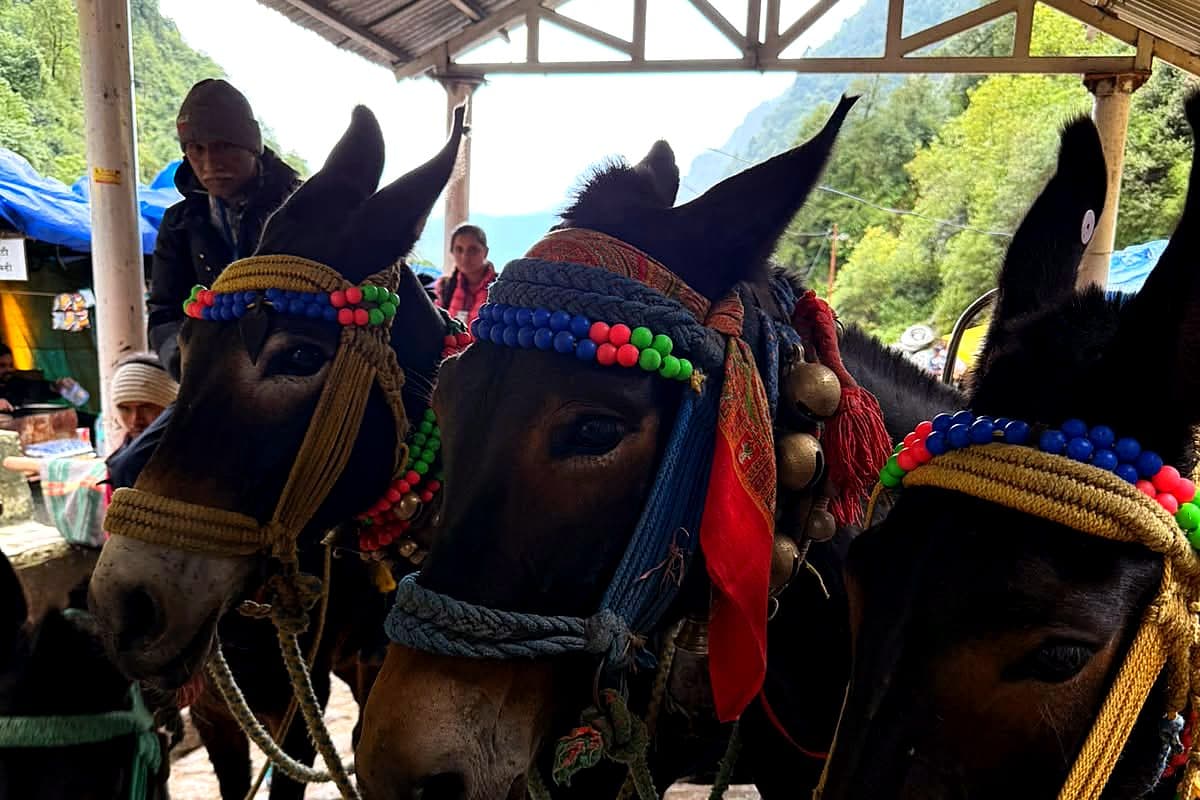
The 2026 rates at a glance
Every figure in this table is printed on an official card. Dandi and kandi fares come from the Zila Panchayat’s 2026 boards, photographed and transcribed in full below. Mule fares come from the District Magistrate’s card, which is linked as a PDF further down. At the counter there is nothing to negotiate, which is the point.
| Service | Up (Gaurikund → Kedarnath) | Down | Same-day return | Time up |
|---|---|---|---|---|
| Mule / Ponydistrict card, any weight | ₹3,200* | ₹2,300 | ₹5,500two bookings | 3–4 hrs |
| Dandi / Palkipassenger 0–60 kg | ₹9,200 | ₹8,200 | ₹15,200 | 5–7 hrs |
| Dandi / Palkipassenger 101–120 kg | ₹15,200 | ₹14,200 | ₹21,200 | 5–7 hrs |
| Kandiup to 25 kg | ₹6,000 | ₹5,000 | ₹8,000 | 6–7 hrs |
| Kandiup to 50 kg | ₹8,000 | ₹7,000 | ₹12,500 | 6–7 hrs |
| Pitthuluggage only, no printed card | ₹1,000–1,500 | — | — | — |
*The mule fare runs to the Kedarnath base camp, 14 km; on the trail pilgrims usually pay ₹3,000–4,500 for it, which is the gap this page is about. The in-between dandi slabs (61–75, 76–90 and 91–100 kg) are in the full board below. Sonprayag to Gaurikund by shared jeep is an extra ₹50–100 per person and isn’t part of any fare; pay it at the Sonprayag stand.
The 2026 dandi (palki) board, every weight slab
Most pages quoting “official” Kedarnath palki rates give you a range and no document. Here is the board. It is the Zila Panchayat Rudraprayag’s, headed वर्ष 2026 के यात्राकाल के लिए गौरीकुण्ड से केदारनाथ पैदल मार्ग के लिए डण्डी (डोली) की दरें, which means dandi (doli) rates for the Gaurikund–Kedarnath footpath for the 2026 yatra season. Our team photographed it at Gaurikund on 22 September 2026.
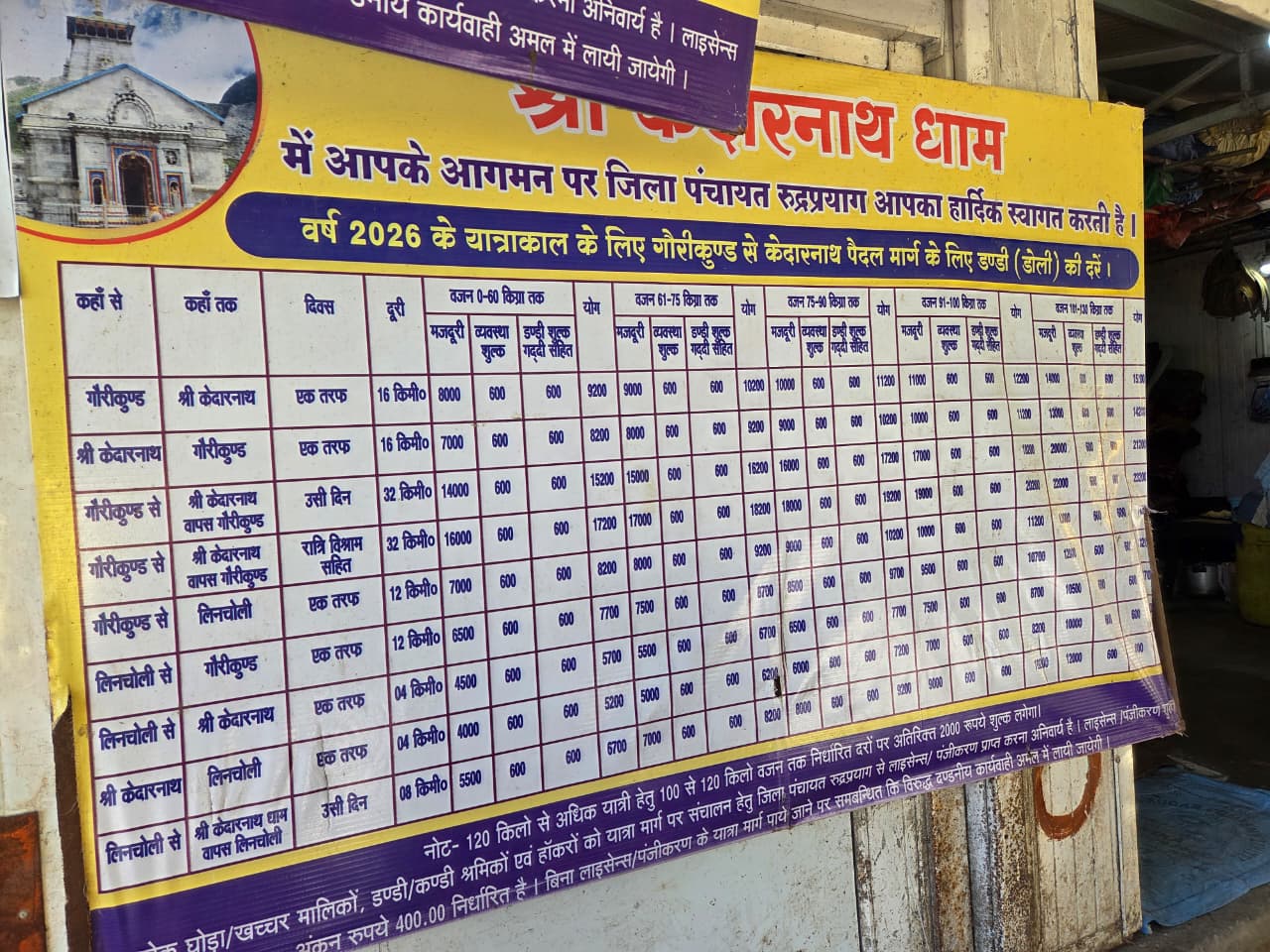
The fare depends on the route and on the passenger’s weight. Every figure is the bearers’ wages plus a ₹600 arrangement fee (vyavastha shulk) plus ₹600 for the dandi itself with its cushion. The table gives the total, which is what your receipt should show.
| Route | 0–60 kg | 61–75 kg | 76–90 kg | 91–100 kg | 101–120 kg |
|---|---|---|---|---|---|
| Gaurikund → Kedarnathone way · 16 km | ₹9,200 | ₹10,200 | ₹11,200 | ₹12,200 | ₹15,200 |
| Kedarnath → Gaurikundone way · 16 km | ₹8,200 | ₹9,200 | ₹10,200 | ₹11,200 | ₹14,200 |
| Gaurikund → Kedarnath and backsame day · 32 km | ₹15,200 | ₹16,200 | ₹17,200 | ₹18,200 | ₹21,200 |
| Gaurikund → Kedarnath and backwith night halt · 32 km | ₹17,200 | ₹18,200 | ₹19,200 | ₹20,200 | ₹23,200 |
| Gaurikund → Lincholione way · 12 km | ₹8,200 | ₹9,200 | ₹10,200 | ₹11,200 | —† |
| Lincholi → Gaurikundone way · 12 km | ₹7,700 | ₹8,700 | ₹9,700 | ₹10,700 | —† |
| Lincholi → Kedarnathone way · 4 km | ₹5,700 | ₹6,700 | ₹7,700 | ₹8,700 | ₹11,700 |
| Kedarnath → Lincholione way · 4 km | ₹5,200 | ₹6,200 | ₹7,200 | ₹8,200 | ₹11,200 |
| Lincholi → Kedarnath and backsame day · 8 km | ₹6,700 | ₹8,200 | ₹9,200 | ₹10,200 | ₹13,200 |
Over 120 kg: the board adds ₹2,000 to the 101–120 kg rate, so Gaurikund to Kedarnath becomes ₹17,200. The board prints the middle slab as “75–90 kg”; 75 kg itself falls in 61–75. †These two cells are unreadable in our photo because of a crease in the banner. Ask at the counter.
Three things the board tells you that a range never will. First, book the return as one booking. A same-day return costs less than an up fare plus a down fare: ₹2,200 less at 0–60 kg and ₹8,200 less at 101–120 kg, because the bearers wait for you at the top instead of finding another fare. Second, keeping them overnight at the top costs exactly ₹2,000 more than the same-day return, at every weight. Third, the slabs climb by ₹1,000 each up to 100 kg and then jump ₹3,000 to the 101–120 kg slab. State the passenger’s weight honestly. The four men carrying the dandi feel every kilo, and a dispute halfway up the trail is worse than the fare.
The 2026 kandi board
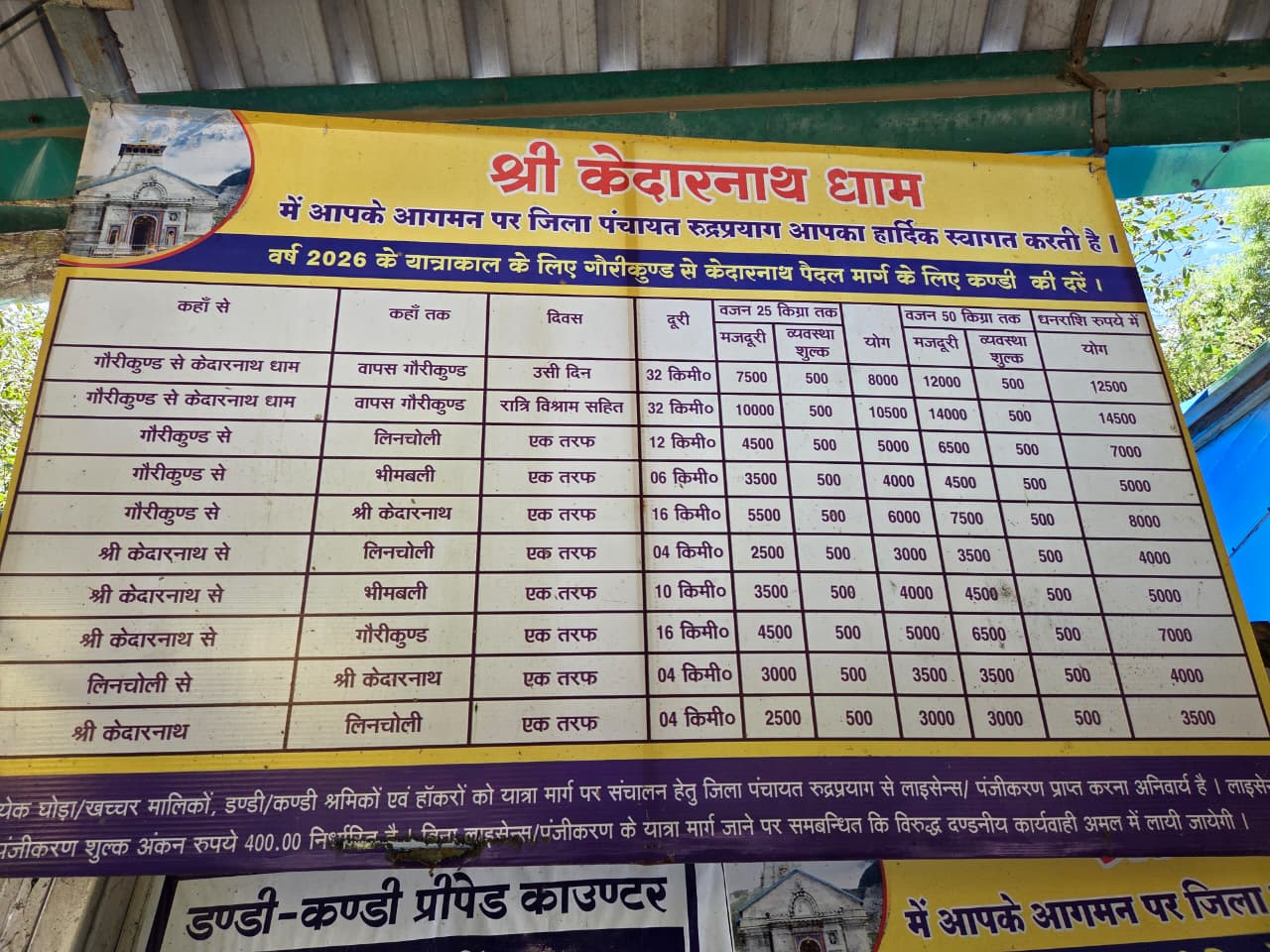
A kandi is a wicker basket on one porter’s back. The Zila Panchayat’s 2026 kandi board has only two weight slabs, up to 25 kg and up to 50 kg, and nothing above that. That makes the kandi a choice for children and very light adults; anyone heavier is on the dandi board. We photographed this one the same day, where it hangs above the dandi–kandi prepaid counter at Gaurikund.
| Route | Up to 25 kg | Up to 50 kg |
|---|---|---|
| Gaurikund → Kedarnathone way · 16 km | ₹6,000 | ₹8,000 |
| Kedarnath → Gaurikundone way · 16 km | ₹5,000 | ₹7,000 |
| Gaurikund → Kedarnath and backsame day · 32 km | ₹8,000 | ₹12,500 |
| Gaurikund → Kedarnath and backwith night halt · 32 km | ₹10,500 | ₹14,500 |
| Gaurikund → Lincholione way · 12 km | ₹5,000 | ₹7,000 |
| Gaurikund → Bhimbalione way · 6 km | ₹4,000 | ₹5,000 |
| Lincholi → Kedarnathone way · 4 km | ₹3,500 | ₹4,000 |
| Kedarnath → Lincholione way · 4 km | ₹3,000 | ₹4,000‡ |
| Kedarnath → Bhimbalione way · 10 km | ₹4,000 | ₹5,000 |
Each total is the porter’s wages plus a ₹500 arrangement fee. ‡The board lists Kedarnath → Lincholi twice, once at ₹4,000 and once at ₹3,500 for the 50 kg slab. If you are quoted either, it is on the board.
The kandi is not the budget option it is often described as. For the climb it costs ₹6,000 to ₹8,000, two to two-and-a-half times the mule’s card fare. For a passenger close to 50 kg, it is only ₹1,200 less than a dandi, which is far steadier. Where the kandi does make sense is a small child, and on the same-day return: ₹8,000 up to 25 kg, against ₹11,000 for two one-way trips.
The mule (pony) card: the district’s notice
Mule fares come from a different office. The District Magistrate, Rudraprayag fixes the ghoda–khachar fares for the Sonprayag–Gaurikund–Kedarnath trail by notice each time they are revised; the current one is Letter 34/Yatra Vyavastha Cell/2024-25, revised 16 May 2024. You can read the notice (PDF, Hindi, 4 pages) on the district site. Each fare below is the mule owner’s fee plus a ₹150 arrangement fee, which is the total your receipt shows. Unlike the dandi board, there are no weight slabs. It is one fare per leg.
| From | To | km | Card rate |
|---|---|---|---|
| Sonprayag | Kedarnath base camp | 19 | ₹3,500 |
| Sonprayag | Lincholi | 16 | ₹2,500 |
| Sonprayag | Bhimbali | 11 | ₹1,700 |
| Sonprayag | Gaurikund | 5 | ₹1,100 |
| Gaurikund | Kedarnath base camp | 14 | ₹3,200 |
| Gaurikund | Lincholi | 11 | ₹2,400 |
| Gaurikund | Bhimbali | 6 | ₹1,200 |
| Gaurikund | Sonprayag | 5 | ₹1,000 |
| Bhimbali | Kedarnath base camp | 8 | ₹1,800 |
| Bhimbali | Gaurikund | 6 | ₹1,200 |
| Kedarnath base camp | Sonprayag | 19 | ₹2,500 |
| Kedarnath base camp | Gaurikund | 14 | ₹2,300 |
| Kedarnath base camp | Bhimbali | 8 | ₹1,300 |
| Kedarnath base camp | Lincholi | 3 | ₹1,000 |
Source: District Magistrate, Rudraprayag, Letter 34/Yatra Vyavastha Cell/2024-25, revised 16 May 2024. The notice covers mules only; dandi and kandi rates are the Zila Panchayat’s, on the two 2026 boards above. No 2025 or 2026 revision of the mule card has been published on the district site as of September 23, 2026; the counters are working from this card.
Three things on the card that most rate pages get wrong. The mule leg from Gaurikund is measured at 14 km to the base camp (the walking trail to the temple is the 16 km everyone quotes). The ride down is cheaper than the ride up — ₹2,300 against ₹3,200 — so a handler quoting the same figure for both legs is already above card. And the card’s first row is Sonprayag to Kedarnath, ₹3,500: mules do start at Sonprayag, and for anyone who cannot manage the jeep queue that is the leg to book.
Official rate vs what touts actually charge
Two bodies set the rates on this trail: the District Magistrate for mules, and the Zila Panchayat for dandi and kandi. Their cards are what the prepaid counters charge and what's printed on your receipt. They're the only figures that are binding. An operator who charges above them is breaking the terms of their licence, and you have a receipt to prove it if you need to complain.
That licence is worth knowing about. The Zila Panchayat’s own boards say every mule owner, dandi or kandi porter and hawker on the route must hold its licence (the fee is ₹400), and that anyone found working without one faces penal action. So a porter who can’t show a licence card is not someone to hand money to.
Outside that counter, on the trail itself, unregistered or loosely affiliated operators quote whatever the moment allows. It's rarely a huge markup on a single ride, but it adds up over a family group, and it comes with none of the recourse a printed receipt gives you. The fix isn't complicated: book at the counter, first thing in the morning, before the day's animals are gone and before anyone on the trail has a reason to approach you.
Photograph the board before you walk off with your receipt. That's how the two boards on this page got here, and it's a habit worth copying. If a handler tries to add a “return supplement” or a “rest-stop charge” halfway up (both are common asks that aren't on any official card), you have the printed rate in your pocket to point back to.
Look up your own fare
Pick the service, the route and the passenger’s weight, and this reads the fare straight off the boards above, with the fee split the receipt should show. Check the number before you’re standing in the queue.
Reads straight off the three official cards on this page. The total on your prepaid-counter receipt should match it.
Source: Zila Panchayat, Rudraprayag, 2026 rate board. Touts on the trail quote above these figures; the counter charges the printed rate.
Pony vs palki vs kandi vs helicopter — which to pick
| Option | Best for | Trade-off |
|---|---|---|
| Pony | Fit riders comfortable balancing for hours | Sore thighs and back by the end; not ideal with knee or hip issues |
| Palki | Seniors, anyone with balance or joint concerns | About three times the mule fare, priced by weight, and slower |
| Kandi | Small children and very light adults (the board stops at 50 kg) | Cramped, the longest ride time, and not cheap: ₹6,000–8,000 up |
| Helicopter | Time-limited trips, medical caution | Weather-dependent, books out weeks ahead, most expensive — see our helicopter booking guide |
Torn between the two most common choices? Our pony vs helicopter comparison goes through it leg by leg.
Two things people search for — one exists, one doesn’t
“Sonprayag to Kedarnath by horse”
This one does exist, and it is the first row on the district card: Sonprayag to Kedarnath base camp, 19 km, ₹3,500. Most pilgrims still take the shared jeep to Gaurikund (₹50–100) and book from there at ₹3,200, because the mule stand at Gaurikund has more animals and the jeep is quicker than riding the road section. But if the jeep queue is long, or you are travelling with someone who cannot stand in it, booking the mule from Sonprayag is a legitimate, card-priced option — not a tout arrangement.
“Gaurikund to Kedarnath by helicopter”
There is no helipad at Gaurikund. Helicopters fly from Phata, Sersi and Guptkashi, all of which are below Gaurikund on the road, and land at the Kedarnath helipad above the temple. If you are already at Gaurikund, your options are on foot, pony, palki or kandi — the helicopter decision has to be made before you leave the road head.
Route facts at a glance
- Gaurikund to Kedarnath: 16 km on foot to the temple, gaining roughly 1,600 m; the mule leg is measured at 14 km to the base camp
- Kedarnath sits at about 3,583 m above sea level
- Sonprayag to Gaurikund: 5 km, a shared jeep for most pilgrims; mules can also be booked from Sonprayag
- Trail is stone-paved most of the way, with a few steep switchback sections in the upper stretch
The trail runs through a couple of natural rest points, Jungle Chatti and Linchouli being the two most pilgrims stop at, with tea stalls and basic toilets. Pony and palki handlers know these stops well and will pause there without being asked; if yours doesn't and you need a break, just say so. Nobody's paid by the hour, and a reasonable rest doesn't cost you extra.
How to book — step by step
- Complete Char Dham registration in advance at registrationandtouristcare.uk.gov.in — it's checked at the Sonprayag checkpost before you reach Gaurikund.
- Reach Gaurikund early — the prepaid counter opens before sunrise in peak season, and the day's better animals go first.
- For a dandi or kandi, state the passenger’s weight honestly at the counter. The fare is set by the weight slab on the board, not negotiated.
- Take the printed receipt and check the registration number matches the pony, palki team or porter you're handed over to.
- Pay the amount on the receipt — nothing extra unless you're adding a return or changing service mid-route, which goes through the counter too.
In peak weeks — mid-May to mid-June, and again through late September into October — the counter queue can run past an hour by 8 a.m. If you're not staying overnight at Gaurikund, arriving the evening before and booking first thing saves you the wait and gets first pick of animals. During the monsoon lull (July–August) the queue is short but the trail turns slick in places; rates don't change for it, but factor in extra time.
How to avoid scams
Almost every complaint about being overcharged on this trek traces back to one of a handful of habits. Fix these and you're largely covered:
- Book at the counter, not on the trail. Anyone who approaches you directly, especially near the Sonprayag or Gaurikund entry points, is working outside the registered system.
- Insist on the printed receipt with a registration number, and check that number against the animal or team you're actually given before you set off.
- Ask to see the licence. Every mule owner and dandi or kandi porter on this route needs a Zila Panchayat licence. No licence card, no booking.
- Don't pay the full amount upfront to anyone without a receipt in hand. A verbal promise on the trail isn't enforceable.
- Confirm return pricing before you start if you're booking a round trip in two parts; some operators quote a low one-way fare and then raise the return price once you're stuck at the top.
- Watch for fake helicopter and Char Dham booking websites. Book heli seats only through the official IRCTC Heliyatra portal. A wave of look-alike booking sites appears every season and takes advance payments for seats that don't exist.
Note the operator's ID-card number (every registered operator wears one) and go to the tourist police booth at Sonprayag or Gaurikund with your receipt. Emergencies: 112 (police / medical) · 1070 (state disaster helpline).
Total cost breakdown
Pony/palki/kandi fare is one line item in the day, not the whole cost. Roughly, for one pilgrim doing the up-and-down from Gaurikund:
- Budget (walk up, mule down, same day): ₹2,300 mule down on the card + ₹500–800 meals and jeep to Gaurikund + tip. A long single-day trip, best for fit younger travellers.
- Mid-range (mule both ways, one night at Kedarnath): ₹5,500 on the card, ₹6,000–9,000 as usually paid, + ₹1,500–3,000 guesthouse + ₹800–1,200 meals for two days + tip. The most common pattern among our own groups.
- Comfort (palki up, helicopter down): ₹9,200–15,200 palki one way, by weight, + a heli seat booked separately through IRCTC Heliyatra (fares vary by operator and season, so check the portal directly) + meals. The fastest option for anyone short on time or trail-averse.
- Palki both ways, one night at the top: ₹17,200–23,200 as a single booking, by weight, + guesthouse and meals. For anyone who can neither walk nor ride.
For full per-person figures across a multi-day Char Dham itinerary, our Char Dham Yatra cost breakdown walks through budget, mid-range and luxury planning in detail.
What can go wrong — and it's not always about money
Overcharging gets most of the attention, but it's not the only thing worth watching for. Ponies on this route work long, repeated days in thin air on a steep trail, and a tired or overloaded animal is a safety problem for you, not just a welfare one, since a stumble on the switchbacks with a rider aboard is how most trail injuries here actually happen. A well-run counter rotates its animals and won't load beyond the posted weight limit; if a handler pushes you to ignore your stated weight or seems to be rushing an obviously tired animal, that's a reason to ask for a different one, not to just get on and hope.
The same goes for porters carrying a kandi or a palki pole for six or seven hours at altitude, and a short pause when they ask for one isn't a delay tactic; it's the job. Treat the people and animals doing the actual carrying with that in mind, and the trip goes better for everyone, including you.
Senior citizens & medical fitness
The altitude, not the pony or palki itself, is what catches people out. Anyone over 60, or with a history of heart or lung trouble, should get checked at the Gaurikund medical camp before starting; it's free and takes a few minutes. Palki is the gentler option for joints and balance, but it doesn't reduce altitude risk; carry any regular medication with you, not in luggage sent ahead by pitthu. If you're travelling with elderly parents, our Kedarnath yatra packages arrange the registration, hotel and counter logistics so your family isn't doing this cold at 4 AM.
Frequently asked questions
We've run the Gaurikund route. Tell us who's travelling and we'll plan the trek, pony/palki and registration around them — ₹0 to enquire, no advance to talk.
Related reading
- Kedarnath trek guide — distance, difficulty & what to expect
- Gaurikund — where the Kedarnath trek starts
- Kedarnath VIP darshan — price & booking
- Kedarnath registration 2026
- Haridwar to Kedarnath — routes & fares
- Char Dham road status — live route updates
Dandi and kandi fares: Zila Panchayat, Rudraprayag, rate boards for the 2026 yatra season on the Gaurikund–Kedarnath footpath, photographed by our team at Gaurikund on 22 September 2026 (dandi board, kandi board). Mule fares: District Magistrate, Rudraprayag, Letter 34/Yatra Vyavastha Cell/2024-25, revised 16 May 2024 (PDF). The mule band pilgrims actually pay and the luggage-pitthu range are what our groups paid on the route; neither is on a printed card. Registration: registrationandtouristcare.uk.gov.in. Helicopter bookings: heliyatra.irctc.co.in.
Dhanesh Chandra Mishra is a retired Indian Army officer who founded Shiv Ganga Travels in Roorkee, Uttarakhand. His military background — precision, accountability, zero tolerance for shortcuts — defines how the company operates. He has personally driven the Kedarnath and Badrinath routes hundreds of times and remains actively involved in every yatra season.